
Introduction
What was once considered a hobby enjoyed by a small community of gamers has evolved into one of the fastest-growing entertainment industries in the world. Esports, short for electronic sports, has transformed competitive gaming into a global phenomenon that attracts millions of viewers, professional players, corporate sponsors, and investors.
Today, esports tournaments fill massive arenas, generate millions of dollars in prize money, and attract audiences that rival traditional sporting events. Professional gamers have become celebrities, while streaming platforms have created entirely new careers within the gaming ecosystem.
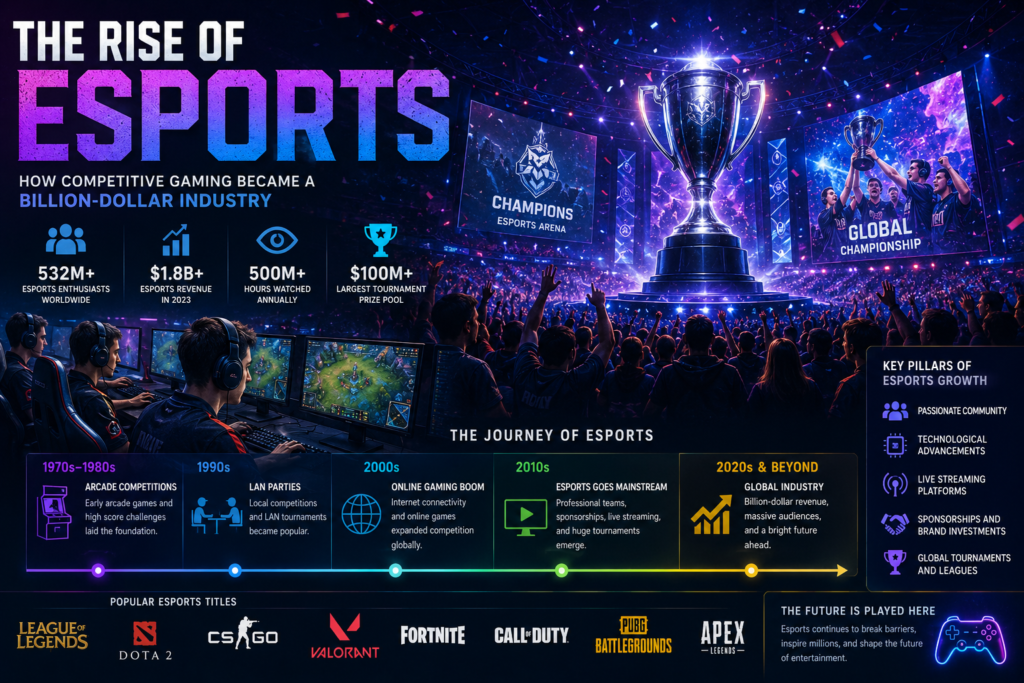
The rise of esports is one of the most remarkable success stories in modern entertainment. From local gaming tournaments held in internet cafes to international championships watched by millions worldwide, competitive gaming has experienced explosive growth over the last two decades.
In this article, we explore how esports became a billion-dollar industry and what the future holds for competitive gaming.
The Early Days of Competitive Gaming
Competitive gaming has existed almost as long as video games themselves.
In the 1970s and 1980s, arcade players competed against one another for high scores. Local gaming competitions were relatively small, but they introduced the idea that gaming could be more than just entertainment.
During the 1990s, the rise of personal computers and local area networks (LAN) allowed gamers to compete directly against one another. Popular titles such as first-person shooters and strategy games created dedicated communities that organized tournaments and competitions.
Although prize pools were modest, these events laid the foundation for modern esports.
The Internet Revolution
The growth of the internet changed everything for competitive gaming.
Online multiplayer gaming allowed players from different countries to compete without being physically present in the same location. This dramatically increased participation and helped gaming communities grow worldwide.
As internet speeds improved, players could compete in real time with minimal delays. Online rankings, matchmaking systems, and global leaderboards added a new level of competitiveness.
Developers began supporting organized competitions, recognizing that competitive scenes could increase player engagement and game longevity.
The internet transformed esports from a local activity into a global phenomenon.
The Birth of Professional Esports
The early 2000s marked the beginning of professional esports organizations.
Teams started recruiting talented players and providing structured training environments. Sponsorship deals began appearing as companies recognized the growing popularity of competitive gaming.
Professional leagues emerged, creating regular competition schedules similar to traditional sports. Players could now earn salaries, sponsorships, and tournament winnings.
Gaming organizations invested in coaching staff, analysts, managers, and content creators. Esports evolved from informal competitions into a legitimate professional career path.
This professionalization helped establish credibility and attracted a wider audience.
Streaming Platforms Fuel Growth
One of the biggest factors behind esports growth has been the rise of live-streaming platforms.
Streaming allows fans to watch matches live from anywhere in the world. Instead of attending events in person, viewers can follow their favorite teams and players online.
Streaming platforms also allow professional gamers to build personal brands and connect directly with audiences. Many players earn substantial income through subscriptions, sponsorships, donations, and advertising revenue.
The accessibility of streaming has expanded esports beyond dedicated gaming communities and introduced competitive gaming to mainstream audiences.
Without streaming technology, esports would likely not have achieved its current level of success.
Massive Tournaments and Prize Pools
Modern esports tournaments rival traditional sporting events in scale and production quality.
Major competitions feature professional broadcasts, expert commentators, advanced statistics, and elaborate stage designs. Events are often hosted in large arenas filled with thousands of fans.
Prize pools have also reached extraordinary levels. Some tournaments offer millions of dollars in rewards, attracting the world’s best players and teams.
These high-stakes competitions generate excitement, media coverage, and increased investment in the industry.
As prize money grows, more players are motivated to pursue esports professionally.
Sponsorships and Brand Partnerships
Corporate sponsorships have played a critical role in esports’ financial success.
Technology companies were among the first to support esports, providing gaming hardware, peripherals, and software. As audiences expanded, brands from many industries began investing in competitive gaming.
Today, esports partnerships include:
- Technology companies
- Energy drink brands
- Telecommunications providers
- Automotive companies
- Apparel manufacturers
- Financial services firms
Sponsors recognize that esports audiences are highly engaged and digitally connected. This makes competitive gaming an attractive marketing platform.
Brand partnerships generate significant revenue for teams, leagues, tournament organizers, and players.
The Rise of Esports Organizations
Modern esports organizations operate similarly to professional sports franchises.
These organizations manage multiple teams across various games and employ large staffs to support player development and business operations.
Successful esports organizations invest in:
- Player training facilities
- Performance coaching
- Mental health support
- Content production
- Marketing and branding
- Community engagement
Many organizations have expanded into merchandise sales, media production, and educational initiatives.
Their growth reflects the increasing maturity of the esports industry.
Universities and Esports Education
The influence of esports has extended into education.
Many colleges and universities now offer esports programs, scholarships, and dedicated training facilities. Students can compete while pursuing academic degrees, similar to traditional collegiate athletics.
Educational institutions recognize that esports can teach valuable skills such as teamwork, communication, leadership, strategic thinking, and problem-solving.
Additionally, esports has created demand for careers beyond professional play, including event management, broadcasting, marketing, coaching, and game development.
As educational opportunities expand, esports continues gaining legitimacy worldwide.
The Impact of Esports on Gaming Culture
Esports has fundamentally changed gaming culture.
Competitive gaming has encouraged players to improve their skills, learn advanced strategies, and participate in communities centered around teamwork and competition.
Professional players inspire millions of fans and influence gaming trends globally. Popular tournaments often shape the popularity and longevity of specific games.
Esports has also fostered international connections, bringing together players and fans from diverse backgrounds through a shared passion for gaming.
The cultural impact of esports extends far beyond competition itself.
Challenges Facing the Industry
Despite its success, esports faces several challenges.
Player burnout remains a concern due to demanding training schedules and intense competition. Maintaining long-term player health and well-being is essential for sustainable growth.
The industry must also address issues related to competitive integrity, player contracts, and financial stability.
Additionally, some esports titles experience fluctuating popularity, making long-term planning difficult for organizations and investors.
However, ongoing innovation and increased professional standards continue helping the industry overcome these obstacles.
The Future of Esports
The future of esports looks incredibly promising.
Advancements in technology will continue enhancing competitive gaming experiences for both players and viewers. Artificial intelligence, virtual reality, cloud gaming, and improved broadcasting technologies may introduce entirely new forms of competition.
Mobile esports is also experiencing rapid growth, particularly in emerging markets where smartphones are more accessible than gaming PCs or consoles.
As internet infrastructure improves globally, esports audiences are expected to expand significantly.
Industry experts predict continued growth in sponsorship revenue, media rights, merchandising, and international competition.
Competitive gaming is likely to become even more integrated into mainstream entertainment over the coming years.
Conclusion
The rise of esports from small local competitions to a billion-dollar global industry represents one of the most significant developments in modern entertainment. Through technological innovation, professional organization, streaming platforms, and passionate communities, competitive gaming has evolved into a worldwide phenomenon.
Today, esports offers career opportunities, educational programs, international competitions, and entertainment experiences that rival traditional sports. Millions of fans tune in to watch their favorite teams compete, while organizations continue investing in the industry’s future.
As technology advances and audiences grow, esports is poised to reach even greater heights. What began as friendly gaming competitions has become a powerful global industry that continues shaping the future of entertainment, sports, and digital culture.