
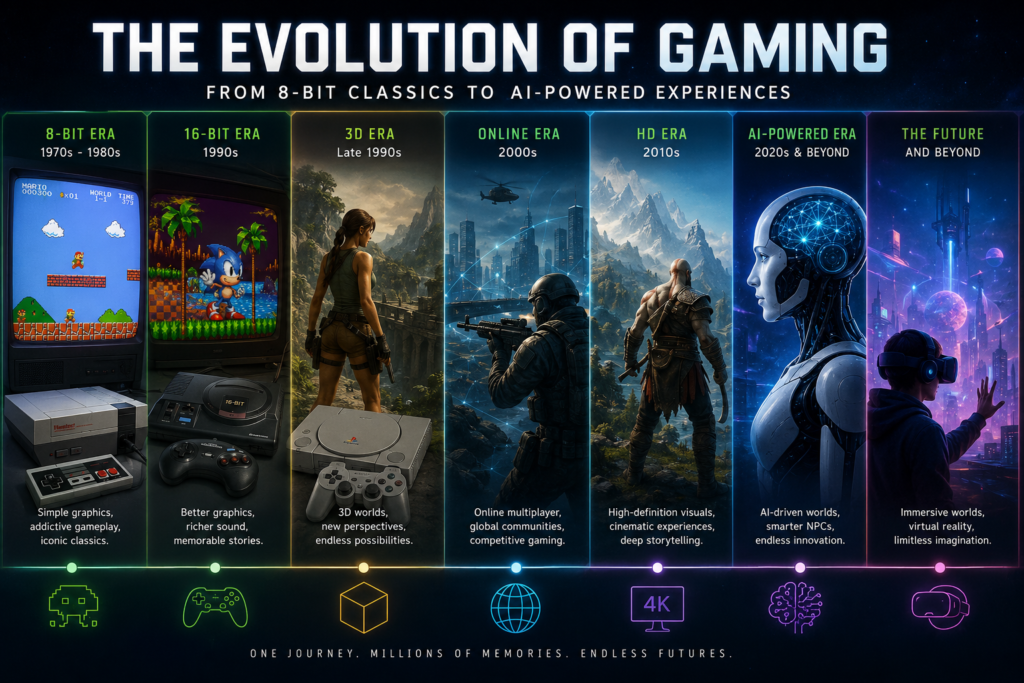
Introduction
The gaming industry has undergone one of the most remarkable transformations in entertainment history. What began as simple pixelated games on arcade machines and early consoles has evolved into a multi-billion-dollar industry powered by cutting-edge technologies such as artificial intelligence, virtual reality, cloud computing, and advanced graphics engines.
Today, gamers can explore vast open worlds, interact with intelligent non-player characters, compete in global esports tournaments, and even experience games through virtual reality headsets. The journey from 8-bit classics to AI-powered experiences showcases not only technological advancement but also the growing influence of gaming on culture, education, and social interaction.
In this article, we explore the fascinating evolution of gaming and examine how it has transformed over the decades into one of the most powerful forms of digital entertainment.
The Birth of Video Games: The 1970s and Early Arcade Era
The origins of gaming can be traced back to the early 1970s when arcade machines began appearing in public spaces. Games such as Pong introduced players to interactive entertainment in a way that had never been experienced before.
These early games were simple by today’s standards. Graphics consisted of basic shapes and limited movements, while gameplay focused on straightforward objectives. Despite their simplicity, arcade games quickly became a cultural phenomenon.
Arcades served as social hubs where players competed for high scores and enjoyed a new form of entertainment. This period laid the foundation for what would become a global gaming industry.
The Rise of 8-Bit Gaming
The late 1970s and 1980s marked the arrival of home gaming consoles. Systems such as the Nintendo Entertainment System (NES) and Sega Master System brought gaming into households around the world.
The 8-bit era introduced iconic games that continue to influence modern game design. Titles featuring adventurous heroes, side-scrolling levels, and memorable soundtracks became staples of gaming culture.
Although hardware limitations restricted graphics and processing power, developers used creativity to deliver engaging gameplay experiences. Many classic franchises that remain popular today originated during this period.
The 8-bit generation demonstrated that compelling gameplay could overcome technological limitations and establish lasting connections with players.
The 16-Bit Revolution
As technology improved, gaming entered the 16-bit era during the late 1980s and early 1990s. Consoles such as the Super Nintendo Entertainment System (SNES) and Sega Genesis offered enhanced graphics, improved sound quality, and more complex gameplay mechanics.
Developers gained access to greater processing power, allowing them to create larger worlds and more detailed characters. Storytelling became increasingly important, with games featuring deeper narratives and emotional experiences.
The competition between Nintendo and Sega fueled innovation, resulting in some of the most beloved games in history. This era proved that gaming could provide rich storytelling alongside exciting gameplay.
The Arrival of 3D Gaming
The mid-1990s brought one of the most significant milestones in gaming evolution: the transition from 2D to 3D graphics.
Consoles such as the Sony PlayStation and Nintendo 64 introduced players to immersive three-dimensional worlds. Instead of moving characters across flat environments, gamers could now explore expansive landscapes with greater freedom.
This technological leap revolutionized game design. Developers created open environments, dynamic camera systems, and realistic character movements. Genres such as first-person shooters, racing simulators, and open-world adventures flourished during this era.
The move to 3D gaming fundamentally changed player expectations and established the foundation for modern game development.
Online Gaming Changes Everything
The late 1990s and early 2000s witnessed another major transformation with the rise of internet connectivity.
Online gaming enabled players to connect with others around the world, creating communities that transcended geographical boundaries. Multiplayer experiences became more engaging and competitive than ever before.
Massively multiplayer online games introduced persistent virtual worlds where thousands of players could interact simultaneously. Competitive online gaming also began gaining popularity, setting the stage for the esports industry.
The internet transformed gaming from a primarily solo activity into a global social experience.
High-Definition Gaming and Realistic Graphics
As hardware capabilities continued to improve, gaming entered the high-definition era. Consoles such as the PlayStation 3, Xbox 360, PlayStation 4, and Xbox One delivered unprecedented visual quality.
Advanced graphics engines enabled realistic lighting, detailed textures, and lifelike character animations. Motion capture technology allowed developers to create cinematic storytelling experiences that rivaled Hollywood productions.
Games became larger, more immersive, and increasingly sophisticated. Open-world titles offered hundreds of hours of content, while online services provided continuous updates and downloadable expansions.
The line between movies and video games began to blur as interactive storytelling reached new heights.
The Rise of Esports
One of the most significant developments in modern gaming has been the emergence of esports.
Competitive gaming evolved from small local tournaments into global events watched by millions of viewers. Professional players now compete for substantial prize pools, sponsorships, and international recognition.
Esports has created new career opportunities for players, coaches, analysts, broadcasters, and content creators. Major tournaments fill stadiums and attract audiences comparable to traditional sporting events.
The growth of esports highlights gaming’s transformation into a mainstream entertainment industry.
Virtual Reality and Immersive Experiences
Virtual reality (VR) represents another major step in gaming evolution.
VR technology places players directly inside digital environments, creating a level of immersion that traditional screens cannot match. Players can physically interact with virtual worlds using motion controllers and head-tracking systems.
Although still developing, VR gaming has demonstrated enormous potential for entertainment, education, training, and social interaction.
As hardware becomes more affordable and accessible, virtual reality is expected to play an increasingly important role in the future of gaming.
Artificial Intelligence: The Next Frontier
Artificial intelligence is rapidly transforming the gaming industry.
Traditional game AI focused on controlling enemy behavior through predefined scripts and rules. Modern AI systems are becoming far more sophisticated, enabling dynamic interactions and adaptive gameplay experiences.
AI-powered characters can learn from player actions, adjust difficulty levels, and respond more naturally to changing situations. Procedural content generation allows developers to create expansive worlds and unique experiences with greater efficiency.
Machine learning technologies are also improving game testing, development workflows, and player personalization.
As AI continues to advance, future games may feature intelligent companions, realistic conversations, and worlds that evolve based on individual player choices.
Cloud Gaming and Accessibility
Cloud gaming is changing how players access and enjoy games.
Instead of requiring expensive hardware, cloud gaming services stream games directly from remote servers. This allows players to enjoy high-quality experiences on smartphones, tablets, laptops, and other devices.
Cloud technology reduces hardware barriers and makes gaming more accessible to a broader audience. It also supports cross-platform play and seamless gaming experiences across multiple devices.
As internet infrastructure improves globally, cloud gaming could become a dominant force in the industry.
The Future of Gaming
The future of gaming appears more exciting than ever.
Emerging technologies such as artificial intelligence, augmented reality, blockchain integration, advanced cloud computing, and next-generation graphics engines will continue reshaping the gaming landscape.
Future games may feature fully interactive virtual worlds populated by intelligent characters capable of meaningful conversations and adaptive behaviors. Personalized experiences could be tailored to individual preferences, creating unique adventures for every player.
Gaming will likely continue expanding beyond entertainment into education, healthcare, business training, and social communication.
Conclusion
The evolution of gaming from simple 8-bit classics to sophisticated AI-powered experiences is a testament to human creativity and technological innovation. Over the decades, gaming has transformed from a niche hobby into a global cultural phenomenon that influences millions of lives worldwide.
From arcade machines and home consoles to online multiplayer worlds, esports competitions, virtual reality environments, and artificial intelligence-driven experiences, each technological advancement has expanded the possibilities of interactive entertainment.
As technology continues to evolve, the gaming industry will undoubtedly discover new ways to captivate, connect, and inspire players across the globe. The journey from pixels to intelligent virtual worlds is far from over, and the next chapter in gaming evolution promises to be even more extraordinary than the last.
wvswig