
Introduction
For decades, gaming enthusiasts have faced one major challenge: keeping up with expensive hardware upgrades. Whether it was purchasing the latest gaming console or investing thousands of dollars in a high-performance gaming PC, enjoying modern games often required significant financial commitment.
However, a revolutionary technology is changing the way people play games. Cloud gaming is transforming the gaming industry by allowing players to stream games directly from powerful remote servers instead of relying on expensive local hardware.
Much like video streaming services changed how we watch movies and television, cloud gaming aims to make high-quality gaming accessible to everyone with a stable internet connection. Players can now enjoy demanding games on smartphones, tablets, laptops, smart TVs, and even low-end computers.
As internet infrastructure continues to improve worldwide, cloud gaming is becoming one of the most exciting developments in the future of gaming.
What Is Cloud Gaming?
Cloud gaming is a technology that allows users to play video games through internet streaming rather than running the games directly on their own devices.
Traditionally, games are installed and processed on a console, PC, or mobile device. The device handles graphics rendering, physics calculations, and gameplay processing.
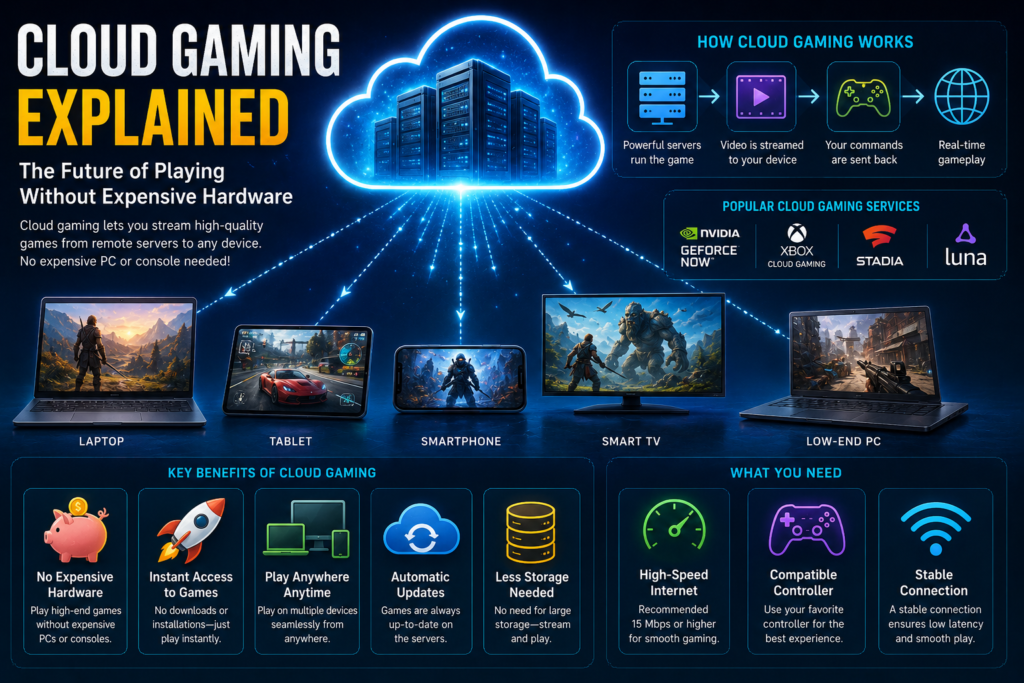
With cloud gaming, all these tasks are performed on powerful remote servers located in data centers. The game is processed in the cloud and streamed to the player’s screen in real time.
Player inputs, such as keyboard commands, controller movements, or touchscreen actions, are sent back to the server almost instantly. This creates an experience similar to playing a game locally.
Essentially, cloud gaming allows users to access powerful gaming hardware without owning it.
How Cloud Gaming Works
The process behind cloud gaming involves several advanced technologies working together.
First, the game runs on high-performance servers equipped with powerful processors and graphics cards. These servers generate the game’s visuals and gameplay.
The server then compresses the video output and streams it to the player’s device through the internet.
At the same time, the player’s commands are transmitted back to the server with minimal delay.
This entire process happens within milliseconds, allowing gameplay to feel smooth and responsive.
The quality of the experience depends largely on internet speed, network stability, and server proximity.
The Biggest Advantages of Cloud Gaming
No Expensive Hardware Required
One of the most attractive features of cloud gaming is the elimination of expensive gaming equipment.
Players no longer need to purchase high-end gaming PCs or the latest consoles. Since the processing occurs remotely, even budget devices can run demanding games.
This significantly reduces the financial barriers associated with gaming.
Instant Access to Games
Traditional gaming often requires lengthy downloads and installations.
Cloud gaming allows players to launch games almost instantly. Since the game runs on remote servers, there is no need to wait for large files to download.
This convenience improves accessibility and user experience.
Play Anywhere
Cloud gaming supports multiple devices, allowing players to continue gaming across different platforms.
A player can start a game on a laptop, continue on a smartphone, and finish on a smart TV without losing progress.
This flexibility makes gaming more convenient than ever before.
Automatic Updates
Game updates, patches, and system maintenance are handled by cloud service providers.
Players do not need to worry about installing updates or managing storage space. The latest version of a game is always available.
Reduced Storage Requirements
Modern games can require hundreds of gigabytes of storage.
Since cloud gaming streams content directly from servers, players do not need large storage drives. This is especially beneficial for mobile devices and lightweight laptops.
The Role of High-Speed Internet
The success of cloud gaming depends heavily on internet connectivity.
Unlike traditional gaming, cloud gaming requires a constant connection to remote servers. A slow or unstable network can result in lag, reduced image quality, or interruptions.
The rollout of faster broadband connections and advanced mobile networks has significantly improved cloud gaming performance.
As internet infrastructure continues to advance globally, cloud gaming services will become more reliable and accessible.
Cloud Gaming vs Traditional Gaming
Cloud gaming and traditional gaming each offer unique advantages.
Traditional gaming provides complete ownership of hardware and often delivers the lowest possible latency. Players can enjoy games even without an internet connection.
Cloud gaming, on the other hand, prioritizes convenience and accessibility. Players gain access to powerful gaming systems without the need for expensive purchases.
For many gamers, the choice depends on individual preferences, internet quality, and budget considerations.
Rather than replacing traditional gaming entirely, cloud gaming is likely to exist alongside it.
How Cloud Gaming Is Expanding the Gaming Audience
One of the most significant impacts of cloud gaming is increased accessibility.
Many people cannot afford expensive gaming hardware. Cloud gaming lowers the entry barrier, allowing more individuals to participate in gaming.
Students, casual players, and users in developing markets can access high-quality gaming experiences using affordable devices.
This expansion helps gaming companies reach larger audiences and create new business opportunities.
The democratization of gaming is one of cloud gaming’s greatest achievements.
The Impact on Game Developers
Cloud gaming is also changing how developers create and distribute games.
Developers can build larger and more ambitious experiences without being limited by consumer hardware capabilities.
Since cloud servers handle processing tasks, games can potentially feature more advanced artificial intelligence, larger worlds, and enhanced graphics.
Cloud platforms also simplify distribution by reducing concerns related to hardware compatibility and installation issues.
As cloud technology improves, developers may gain even greater creative freedom.
Challenges Facing Cloud Gaming
Despite its potential, cloud gaming still faces several obstacles.
Internet Dependence
A reliable internet connection remains essential.
Players in areas with slow internet speeds may experience performance issues that affect gameplay quality.
Latency Concerns
Even small delays between player input and server response can impact competitive games.
Reducing latency remains a major focus for cloud gaming providers.
Data Usage
Streaming games requires significant bandwidth.
Users with limited internet plans may encounter data restrictions or additional costs.
Infrastructure Costs
Operating global data centers requires substantial investment.
Cloud gaming companies must continue expanding infrastructure to serve growing audiences effectively.
Artificial Intelligence and Cloud Gaming
Artificial intelligence is expected to play an important role in the future of cloud gaming.
AI can optimize streaming quality, predict player behavior, and reduce latency through intelligent resource allocation.
Machine learning systems can dynamically adjust graphics settings based on network conditions, ensuring smooth gameplay experiences.
AI-driven improvements will likely enhance both performance and personalization in cloud gaming environments.
The Future of Cloud Gaming
The future of cloud gaming looks extremely promising.
As internet speeds increase and technologies such as 5G and future network innovations become widespread, cloud gaming performance will continue improving.
More players will gain access to premium gaming experiences without expensive hardware investments.
Cloud gaming could eventually become the primary method of accessing games, much like streaming services have become the preferred way to consume movies and music.
Additionally, cloud gaming may integrate with virtual reality, artificial intelligence, and cross-platform ecosystems to create entirely new gaming experiences.
The industry is still in its early stages, but its potential is enormous.
Conclusion
Cloud gaming represents one of the most significant innovations in modern gaming. By removing the need for expensive hardware, it makes high-quality gaming more accessible, convenient, and flexible than ever before.
Although challenges such as latency and internet dependence remain, ongoing technological advancements are steadily addressing these concerns.
As broadband infrastructure improves and cloud technology continues to evolve, millions of players worldwide will gain access to immersive gaming experiences regardless of the devices they own.
The future of gaming is increasingly moving toward the cloud, and for many players, that future has already begun.