
Introduction
The gaming industry continues to evolve at an extraordinary pace. What was once a niche form of entertainment has become a global phenomenon that influences technology, media, education, and social interaction. With billions of players worldwide and continuous technological advancements, gaming is entering a new era filled with innovation and exciting opportunities.
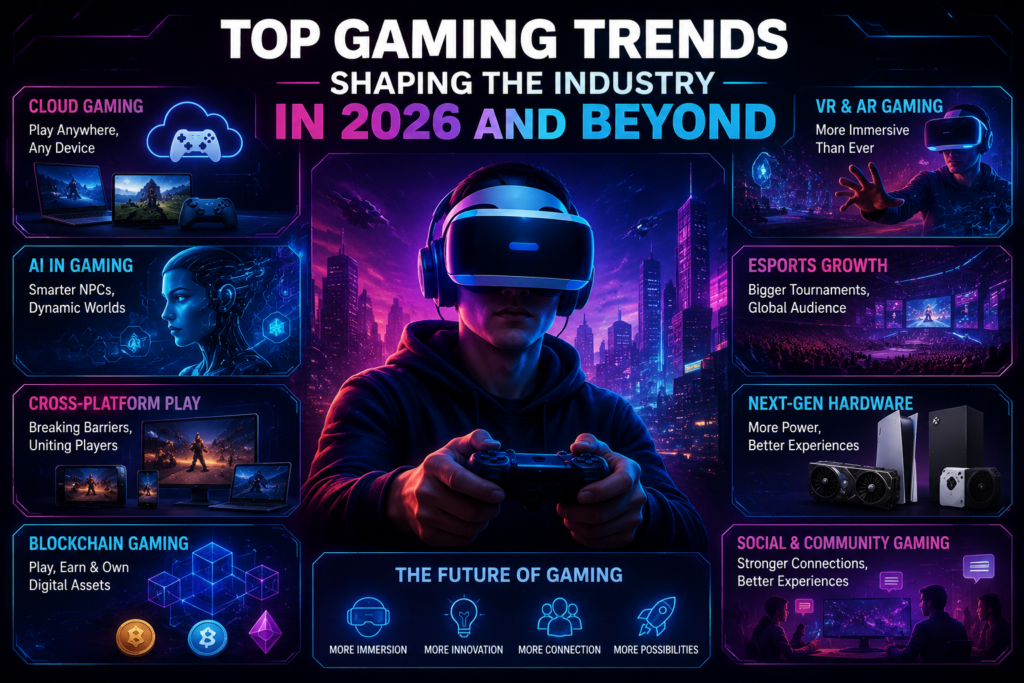
In 2026, the industry is being transformed by powerful technologies such as artificial intelligence, cloud computing, virtual reality, and advanced graphics engines. These innovations are changing how games are developed, played, and experienced.
From AI-generated worlds to immersive virtual environments and global esports competitions, the future of gaming looks more exciting than ever. Players are gaining access to richer experiences, while developers are discovering new ways to create engaging and interactive content.
This article explores the top gaming trends shaping the industry in 2026 and beyond and examines how they will influence the future of entertainment.
1. Artificial Intelligence Is Revolutionizing Gaming
Artificial Intelligence (AI) is becoming one of the most important technologies in modern game development.
Traditionally, non-player characters (NPCs) followed scripted behaviors. However, AI-powered systems are making characters smarter, more realistic, and more responsive to player actions.
Developers are increasingly using machine learning algorithms to create dynamic gameplay experiences. AI can analyze player behavior and adapt game difficulty, missions, and storylines accordingly.
Procedural generation powered by AI is also helping developers create vast open worlds, unique quests, and realistic environments more efficiently than ever before.
In the future, players may interact with intelligent virtual characters capable of natural conversations and personalized responses, making games feel more alive and immersive.
2. Cloud Gaming Continues to Expand
Cloud gaming is rapidly changing how players access games.
Instead of relying on expensive gaming PCs or consoles, players can stream games directly from powerful remote servers. This allows users to enjoy high-quality gaming experiences on smartphones, tablets, laptops, and smart televisions.
As internet infrastructure improves globally, cloud gaming services are becoming more reliable and accessible.
Benefits of cloud gaming include:
- No expensive hardware requirements
- Instant access to games
- Cross-device compatibility
- Reduced storage needs
- Automatic updates and maintenance
Many industry experts believe cloud gaming will become one of the dominant gaming platforms in the coming years.
3. Virtual Reality Becomes More Mainstream
Virtual Reality (VR) gaming continues gaining popularity as hardware becomes more affordable and user-friendly.
Modern VR systems provide highly immersive experiences that place players directly inside digital environments. Motion tracking, spatial audio, and advanced graphics create levels of immersion that traditional gaming cannot match.
Developers are increasingly creating games specifically designed for virtual reality, leading to innovative gameplay mechanics and storytelling techniques.
Future VR systems are expected to offer:
- Higher display resolutions
- Improved motion tracking
- Wireless connectivity
- Enhanced comfort
- More realistic interactions
As technology advances, VR may become a standard part of gaming rather than a specialized niche.
4. Augmented Reality Creates New Experiences
Augmented Reality (AR) blends digital elements with the real world.
Unlike VR, which creates entirely virtual environments, AR overlays digital content onto physical surroundings using smartphones, tablets, or specialized glasses.
Gaming companies continue exploring innovative AR experiences that encourage exploration, social interaction, and real-world engagement.
Future AR games may integrate seamlessly into everyday environments, creating interactive experiences that blur the boundaries between physical and digital worlds.
This technology has enormous potential for gaming, education, tourism, and entertainment.
5. Esports Continues Its Global Growth
Esports has become one of the fastest-growing sectors within the gaming industry.
Professional gaming tournaments now attract millions of viewers and offer substantial prize pools. Esports organizations, sponsors, and media companies continue investing heavily in competitive gaming.
Several factors are driving esports growth:
- Increased streaming viewership
- Expanding international tournaments
- Greater sponsorship investment
- Improved broadcasting technology
- Growing university esports programs
As competitive gaming becomes more mainstream, esports is expected to reach even larger audiences worldwide.
6. Cross-Platform Gaming Is Becoming Standard
Players increasingly expect the ability to play with friends regardless of their chosen platform.
Cross-platform gaming allows users on PCs, consoles, and mobile devices to compete and cooperate within the same game environment.
This trend improves accessibility and helps gaming communities remain connected.
Developers recognize that cross-platform support can significantly increase player engagement and game longevity.
As technology evolves, platform barriers will continue disappearing, creating more unified gaming ecosystems.
7. Mobile Gaming Dominates Global Markets
Mobile gaming remains the largest segment of the gaming industry.
Modern smartphones offer impressive processing power capable of delivering console-quality gaming experiences.
Several factors contribute to mobile gaming’s success:
- Accessibility
- Affordable hardware
- Massive player base
- Global reach
- Continuous technological improvements
Mobile esports, cloud gaming integration, and advanced mobile processors are expected to drive further growth throughout the coming years.
For many players around the world, smartphones represent their primary gaming platform.
8. Advanced Graphics and Realism
Graphics technology continues reaching new levels of realism.
Modern game engines produce stunning visuals featuring realistic lighting, detailed environments, and lifelike character animations.
Technologies driving graphical advancements include:
- Real-time ray tracing
- AI-assisted rendering
- High-resolution textures
- Advanced physics simulations
- Improved animation systems
These innovations help create immersive worlds that feel increasingly authentic and believable.
Future games may become nearly indistinguishable from real-life footage in certain scenarios.
9. Social Gaming and Virtual Communities
Gaming is becoming increasingly social.
Players now use games not only for entertainment but also for communication, collaboration, and community building.
Online multiplayer experiences continue evolving into social platforms where users can:
- Meet new people
- Attend virtual events
- Participate in shared activities
- Create content together
- Build digital communities
The concept of gaming as a social experience will continue expanding as virtual environments become more sophisticated.
10. The Emergence of the Metaverse
The idea of interconnected virtual worlds is gaining momentum.
Often referred to as the metaverse, these digital ecosystems aim to combine gaming, social interaction, commerce, education, and entertainment into unified virtual environments.
Although still developing, many gaming companies are investing heavily in technologies that support persistent virtual worlds.
Future players may move seamlessly between different digital experiences while maintaining identities, assets, and social connections.
The metaverse could fundamentally transform how people interact online.
Challenges Facing the Gaming Industry
Despite rapid growth, the industry faces several challenges.
These include:
- Data privacy concerns
- Cybersecurity threats
- Player toxicity
- Hardware shortages
- Development costs
- Regulatory issues
Addressing these challenges will be critical for ensuring sustainable industry growth.
Developers, publishers, and technology companies must continue working together to create safe and inclusive gaming environments.
The Future of Gaming
The future of gaming is incredibly promising.
Artificial intelligence, cloud computing, virtual reality, augmented reality, and advanced networking technologies will continue pushing the boundaries of interactive entertainment.
Players can expect:
- More intelligent game worlds
- Greater immersion
- Better accessibility
- Enhanced social experiences
- Personalized gameplay
- Seamless cross-platform integration
Gaming will likely play an increasingly important role in education, business, healthcare, and communication beyond traditional entertainment.
Conclusion
The gaming industry in 2026 is experiencing one of the most transformative periods in its history. Innovations such as artificial intelligence, cloud gaming, virtual reality, augmented reality, esports, and advanced graphics technologies are reshaping how games are created and enjoyed.
As these trends continue evolving, players will gain access to more immersive, connected, and personalized experiences than ever before. Developers will benefit from powerful new tools that expand creative possibilities and redefine interactive entertainment.
The future of gaming is not just about playing games—it is about experiencing entirely new digital worlds. With technology advancing at an unprecedented pace, the next decade promises to be one of the most exciting eras the gaming industry has ever seen.
Nội dung hay và thực tế. Letco là đơn vị du học Hàn Quốc giàu kinh nghiệm, đồng hành cùng học viên từ A-Z. Ghé letco.vn để được tư vấn miễn phí.
ekwjsxrxtqenolnvqrzmqolgumoqvl